Friday, April 1, 2011

Fernanda's late post -__-


Caribbean Cultural Center and African Diaspora Institute was the exciting day of the week for me. At the center we learned the history of Santeria. I was very connected to lady that was talking because she was part of this religion and I have learned history of Santeria. Santeria to me plays a BIG HUGE  part of my life. I also learned how to dance also the fact that every dance step has a meaning to the dance. the lady that was talking gave ME a GIFT. it was a book called "The Alter of My Soul". I don't like to read but this cook is very interesting and I love it!!!!!! 


Exploring The Hidden Culture of Corona

Today our group traveled to a place that makes freshly made tortillas. We got a full tour of the building and we were able to see where they make the tortillas. They allowed us to make our own tamales and tortillas! The experience was so much fun and so unique. The food was delicious and filled me up so quickly. I had chicken tacos for lunch and an Oreo ice Popsicle for dessert. I really enjoyed my time with everyone today, yet again!

~`Erica Faith`~

Colorful Culture

Yesterday on March 28th, 2011, we got to travel to Girelle’s house and cook food dishes from a few different cultures. The combinations of aromas filled the entire house and were delicious. We cooked chicken, rice and rosewater and chocolate pudding. We also made a fruit salad! The puddings originated from Mexico and The Dominican Republic. Girelle combined both types of recipes which combined milk with rosewater to make it creamier. I liked Girelle’s version better! Through this experience, I learned how to cook more complex and colorful dishes and I had the chance to enjoy really good quality time with everyone in the group. I LOVE YOU GUYS!!!

~`Erica Faith`~

Thursday, March 31, 2011

Field Trip to Tortilleria Nixtamal

These are all the tamales we made
Today was awesome even though I got to Tortilleria Nixtamal a few minuets late. I loved the way it was styled, half factory and half restaurant. The owner of the restaurant took us downstairs where all the corn was soaked, then grinded into a powder like texture. The grounded corn is used to make tortillas and tamales.At first we watched one of the workers, showing us step by step on how to make tamales, and then we had the opportunity to make some of our own.
The lady showing us the process in making sweet tamales:)


After seeing all these wonderful machines and making tamales, we went upstairs for lunch.It was amazing because the food looked small; you'd never think you'd be full.


Laura's Mother joined us for the day :)

 Saoussan:)
The corn grinder 


Ubiquitous History


As students and teachers it is easy to get caught up inside history textbooks. I am thankful for this week because our experiences have been reminded me, again and again, that history is not set in stone as written in textbooks and that examining our own cultures and histories help us reaffirm our identities and make our lives richer.

History was alive in the voice of Yao as she explained that at least one million people speak Nahualt, the language of the Aztecs, and that millions more use the Aztec calendar and practice its religious traditions and dances. The Aztecs came to life again as Laura taught us how to dance their music and salute the four winds. The Aztecs became real when we made tamales and tortillas like the ones Sahagun described 600 years ago. 

When we prepared ceviche and chicha yesterday, we re-enacted a culinary tradition that has digressed little from its original Inca roots. Pairing chifles with our ceviche demonstrated that, although tragic, the encountered between Incas and Spaniards also produced good things. 


Today, the African Diaspora was no longer confined to a chapter in a book. We experienced it as we listened to Melody explain why people of African descend stay connected deities like chango, ochun, babalua and yamaya. Dancing slave music from Trinidad, we celebrated African culture in the Americas with our hands, feet and laugh.


In school we were taught about feet binding, indenture servitude and the 1959 Cuban Revolution. Today these three “concepts” became real through Dona Caridad. Born in Cuba to Chinese parents, Dona Caridad spoke of female relatives in China whose feet had been bound in hope of marrying into wealth, how her father came to Cuba from China to work as an indenture servant, how he won the lottery and set up businesses that made him rich, and how his fortune was confiscated after the Cuban Revolution and replaced with monthly food rations and a $60 dollar allowance. Her talk ended with a reminder to work hard and steadily, for this is the only way to take ownership over our own histories.


-Girelle


carribean culture day!!


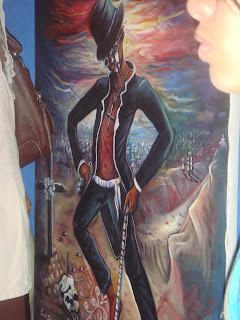
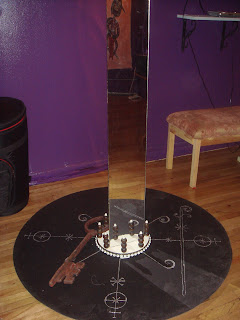
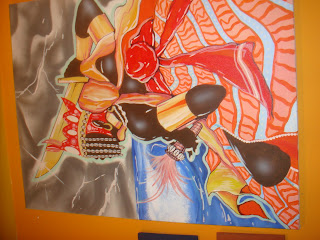
               Today we went to Columbus Circle, in the city.  A lady gave us a tour to show us the statues coming from African, Cuban Dominican, Haiti, Trinidad and Tabago and Puerto Rican.  She told us the meaning of the statues and the pictues that were on the wall.  In a picture, a man(I forgot the name) with a cane standing next to a road, can help you to walk on the road or he decides if he closes the road on you.  If you pray for him and you do what he wants, he'll open the road for you.  If you do something bad sooner or later karma will come back.  He is quite shady.  The picture is a Haitian version by the veves on the drawing.  Veves are  these designs that represent the various powers and attributes of the Loa.  Loa are God, goddesses, spirit, and Orisha.  The African Diaspora refers to the forced enslavement of Africans from Africa to the Western hemisphere. The slaves brought their traditional religions and spiritual beliefs with them, which eventually became cloaked in Christianity in an ingenious move to avoid further persecution.  They made people believe that their religion was mixed with Christianity.  We did a traditional dance form Trinidad and Tabago.  The dance is mixed with Fench and African movements. 
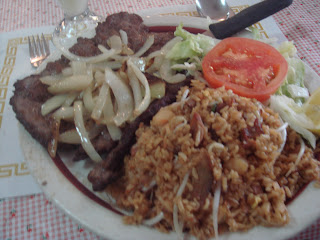
              After that we went to meet up with an old friend named Caridad And her Husband Roberto at a Cuban Chinese restaurant.  We ate either Cuban or Chinese food.  I had both mixed.  After we ate Caridad was talking about her migrating to Cuba.  Her father had worked in a farm, raising animals.  Her father had won a lot of money from dog races.  She said that her dad had long hair and if a man cuts his hair he is no longer a man, but since they were at Cuba he had to cut it.  He still kept his hair, which they still have.  Her dad had Won a lot of money and told Caridad that that is going for her education, but Fidel Castro had taken over and told  almost all his money, land, and properties away.  They had to live with a pound of almost everything for a month for a family.  It was really hard in those conditions. 
DAISY G.

Wednesday, March 30, 2011

Wed., March 30, dance, learn Nahuatl, cook

To help us remember March 30, I will post three photos.   In the morning, Laura shared patience and stamina as well as dance steps.  Yao shared the richness of Nahuatl language, traditions, and beliefs.  In the afternoon, everyone shared in cooking at Girelle's home.  Personally, I have never been so well fed in such pleasant company.  Through food, I better understand  the contributions of Latin America's indigenous Americans, Spanish (European) colonizers, Moors in Spain, and enslaved Africans who were brought to the Americas.  ~Carol